
Blog
Thank You
Blog

Latest Blog & Articles
Stay informed with expert financial insights! Explore our latest blogs on wealth management, retirement planning, and smart investment strategies. Empower your financial future with practical tips and expert advice.

Understanding Indexed Universal Life Insurance
Personal Finance, Cash Value Life Insurance
What Is Indexed Universal Life (IUL)?
Many financially aware individuals come across Indexed Universal Life (IUL) while searching for ways to combine long-term protection with potential tax-advantaged growth. The online conversation can be confusing: some sources promote IUL as a powerful wealth-building tool, while others warn about costs and complexity. If you are asking, “what is IUL, really?” you are likely looking for a clear, even-handed explanation rather than hype or fear. This overview is designed to give you that clarity so you can decide whether it is worth a deeper conversation with a qualified professional.

Calm, financial advisor sitting with a couple at a table, reviewing a simple life insurance on a...
A clear conversation about IUL starts with understanding how the basics work.
What Indexed Universal Life (IUL) Is in Simple Terms
Indexed Universal Life is a form of permanent life insurance. Like other permanent policies, it is designed to provide a death benefit for as long as the policy stays in force, as well as a cash value component that can grow over time. What makes IUL different is how that cash value growth is credited: it is linked to the performance of a financial index, such as the S&P 500, rather than a fixed interest rate chosen by the insurer. The goal is to offer more upside potential than traditional fixed policies, while still protecting against market losses through contractual features like floors and caps.
How IUL Works: Cash Value, Index Linkage, and Flexibility
With an IUL strategy, a portion of each premium goes toward the cost of insurance and policy expenses, and the remainder flows into the policy’s cash value. This cash value can earn interest based on the performance of one or more market indexes selected within the contract. Importantly, the cash value is not directly invested in the stock market; instead, the insurer uses an index-based formula to credit interest, subject to limits such as caps (maximum credited rate) and participation rates (percentage of index gain used in the calculation).
Over time, the cash value in an Indexed Universal Life policy can be accessed through withdrawals or policy loans, if structured correctly and within policy guidelines. IUL is also known for flexibility: within certain limits, you can adjust premium amounts, change death benefit options, and allocate cash value among different index strategies or fixed accounts. That flexibility can be helpful, but it also means the policy must be monitored and managed, especially if you intend to rely on it for future income or other goals.
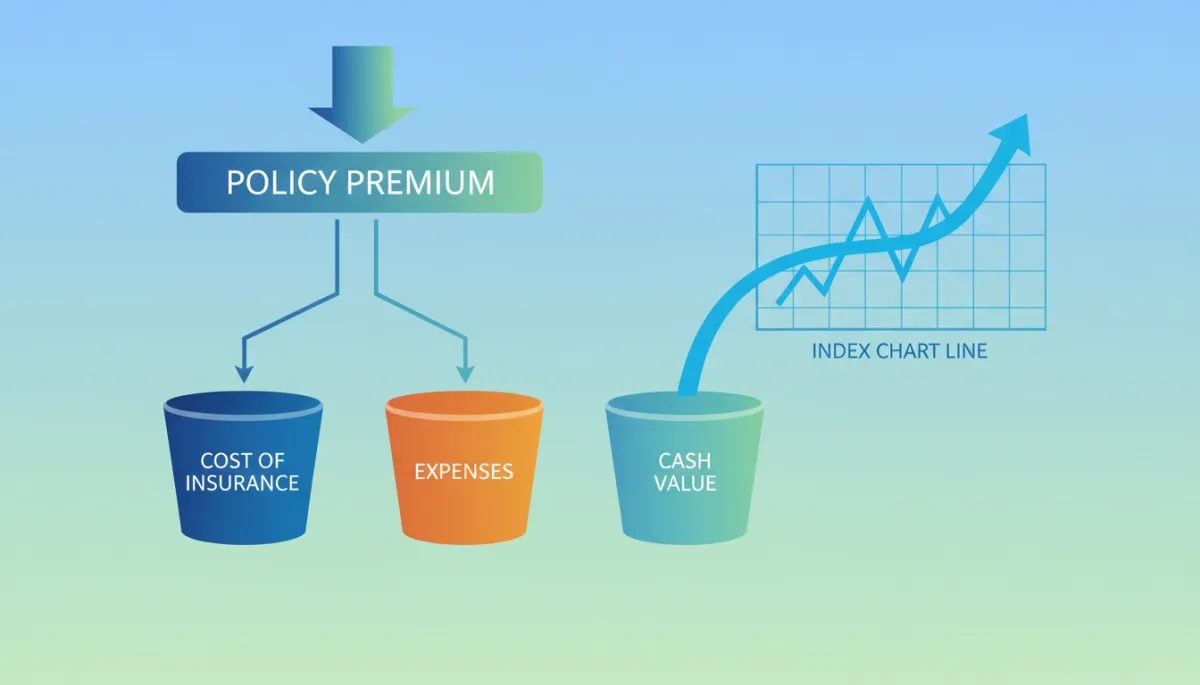
Infographic-style showing a policy premium splitting into cost of insurance, expenses, and cash...
Premiums support the death benefit while building cash value tied to an index.
Why Some Individuals Explore IUL Benefits
People often explore IUL when they want more than just a basic death benefit. Potential IUL benefits can include tax-deferred cash value growth, income-tax-free death benefit to beneficiaries, and the ability to access cash value on a tax-advantaged basis if the policy is designed and managed properly under current tax rules. For some, an IUL strategy is attractive as a supplemental long-term savings tool, sitting alongside retirement accounts and other investments, rather than replacing them.
Others appreciate the idea of participating in a portion of market upside while having downside protection through a guaranteed minimum interest credit (often called a floor). This can feel more comfortable than direct market investing, especially for conservative savers who still want growth potential. However, it is important to remember that these advantages come with trade-offs, including policy costs, caps on growth, and the need to keep the policy properly funded.
Important Considerations: Structure, Timeline, and Suitability
Indexed Universal Life is not a one-size-fits-all solution. Outcomes depend heavily on how the policy is structured, funded, and managed over time. Premium level, death benefit design, index choices, and loan strategy can all affect long-term performance and risk. A poorly designed or underfunded IUL can underperform expectations, require higher premiums later, or even lapse if costs outpace cash value growth.
Time horizon is also crucial. IUL is generally intended as a long-term tool; using it for short-term goals or expecting quick access to large amounts of cash value can lead to disappointment. Surrender charges, ongoing insurance costs, and policy loan interest all need to be understood before committing. Finally, suitability matters: an IUL strategy tends to make more sense for individuals who already have a solid financial foundation, can commit to consistent premiums, and have specific long-term goals that align with cash value life insurance, such as legacy planning or flexible supplemental income.
Conclusion: Is IUL Right for You?
Indexed Universal Life can be a useful tool for some, but it is not inherently “good” or “bad.” Its value depends on your goals, time frame, risk comfort, and how carefully the policy is designed and monitored. If you are curious about what IUL could look like in your situation, it is wise to review detailed illustrations, ask about costs and assumptions, and compare IUL to other permanent life insurance and investment options before deciding.
If you’re exploring whether an IUL strategy fits your goals, you can request a Custom IUL Strategy – Free Consultation to better understand your options.

Secure Your Future Get Your Custom IUL Strategy
Indexed Universal Life (IUL) Strategies
Helping you achieve financial success with expert guidance and personalized strategies.


Opening hours
Mon - Wed : 9AM - 6PM
Thu - Fri: 8AM - 4PM
Sat: 8AM - 2PM
Sunday: Closed
© IUL Benefits. 2026. All Rights Reserved.
PRIVACY POLICY | SUPPORT | TERMS & CONDITION